
Dr. Robert Buonfiglio on Sports Vision Training, the Quiet Eye, and Improving Lacrosse Goalie Performance
Episode Overview
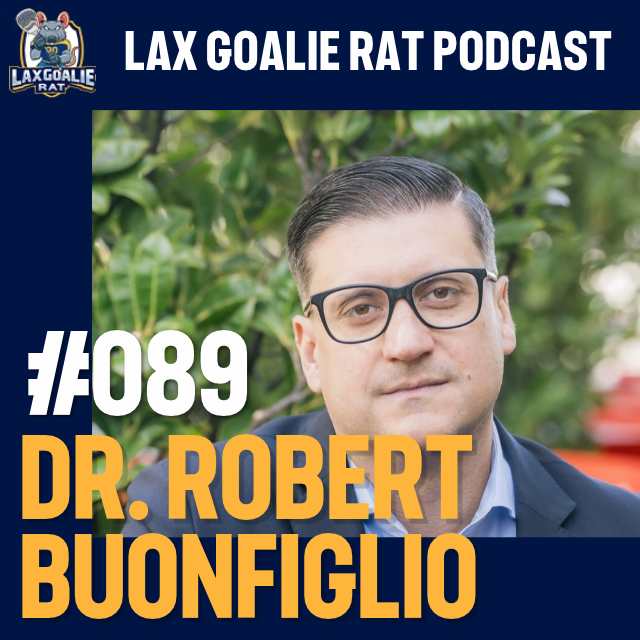
In Episode 89 of the Lax Goalie Rat Podcast, Coach Damon Wilson welcomes Dr. Robert Buonfiglio, an optometrist with extensive experience in sports vision training, including working with professional lacrosse players and the Boston Cannons.
Inspired by the concept of the “quiet eye” introduced at the Virtual Lacrosse Goalie Summit, Coach Damon explores how visual skills influence a goalie’s ability to track the ball, anticipate shots, process information, and make saves.
Dr. Buonfiglio breaks down the science behind eye movements, visual tracking, peripheral awareness, and the connection between the eyes, brain, and body. He also shares practical training methods and tools that athletes can use to improve their visual performance, from HECO sticks and light boards to computer-based exercises and visualization.
Although research has not yet established exactly where elite lacrosse goalies look when making saves, Dr. Buonfiglio explains what studies in other sports suggest and why keeping eye movements efficient may help goalies gather the information they need to react.
Whether you're a youth goalie, an experienced player, or a coach looking for new ways to improve performance, this episode offers a fascinating look at the science of seeing the ball and responding effectively.
What You'll Learn in This Episode
-
The quiet eye concept: What it means, how it was discovered, and why maintaining visual focus around the moment of action can improve performance.
-
How vision affects saves: How the eyes, brain, muscles, and inner ear work together to track the ball and coordinate movements.
-
Pursuit and saccadic eye movements: The difference between smoothly tracking a moving object and shifting your gaze from one point to another.
-
Hard focus versus soft focus: How central and peripheral awareness work together and why goalies need to recognise relevant information without getting distracted.
-
Where goalies should look: What research on hockey goalies and other athletes suggests, and what remains unknown about visual strategies in lacrosse goaltending.
-
Why being set matters: How excessive body movement can make it harder for the brain to process visual information.
-
Sports vision training drills: How strobe glasses, HECO sticks, light boards, and computer-based exercises can challenge visual processing and eye-hand coordination.
-
The role of peripheral awareness: How to practise noticing what's happening around you while maintaining attention on the most important information.
-
Vision training versus muscle training: Why sports vision training focuses on the nervous system and brain rather than strengthening the eye muscles.
-
Video games and reaction time: What Dr. Buonfiglio thinks about video games as a potential tool for developing visual skills.
-
Depth perception and binocular vision: How using both eyes together contributes to depth perception and how people with certain visual limitations may compensate.
-
Visualization and mental rehearsal: How mentally rehearsing a save can complement physical practice.
-
Tracking passes around the perimeter: Why goalies may need to shift their gaze to the next receiver while remaining aware of other players' movements.
Key Takeaways
1. Understand the Quiet Eye
The quiet eye refers to a period of relatively steady visual fixation that begins before a task is completed and continues briefly afterwards.
Dr. Buonfiglio uses putting in golf as an example. Skilled golfers maintain their gaze around the contact point before, during, and after striking the ball rather than immediately following the ball with their eyes.
Research on ice hockey goalies has found a similar pattern, with top performers maintaining fixation on the puck around the moment it leaves the shooter's stick.
For lacrosse goalies, the exact optimal point of visual focus has not yet been established through equivalent research. Dr. Buonfiglio suspects that focusing on the ball as it is released may be beneficial, but further study is needed.
2. Use an Economy of Eye Movement
One of Dr. Buonfiglio's central recommendations is to avoid unnecessary eye movements.
When you shift your gaze rapidly from one object to another, a process called saccadic suppression temporarily reduces visual sensitivity. Excessive shifts can therefore limit the information available to your brain.
Goalies must process a great deal of information during a possession, including the ball, attackers, defenders, positioning, and potential passing options. Learning to focus on relevant information while maintaining peripheral awareness can help make that task more manageable.
3. Develop Both Central and Peripheral Awareness
Dr. Buonfiglio explains the difference between hard focus and soft focus.
-
Hard focus: Concentrating intensely on one specific object, which can make surrounding details less noticeable.
-
Soft focus: Maintaining a broader awareness of the overall scene without concentrating intensely on one particular object.
Goalies need to use both. The ball and its release are important, but awareness of nearby attackers, defenders, and movement around the field also helps them understand what's happening.
Peripheral awareness can be practised in everyday situations by consciously noticing more of your surroundings while keeping your attention appropriately directed.
4. Train Your Brain, Not Just Your Eyes
Sports vision training is primarily about training the nervous system and improving how the brain processes visual information.
Dr. Buonfiglio describes exercises designed to develop tracking, reaction time, eye-hand coordination, and the ability to shift attention efficiently.
He explains that repeated training can help athletes respond more efficiently, although the extent to which every specific exercise transfers directly to better lacrosse goaltending remains an area of ongoing research.
5. Combine Vision Training With On-Field Practice
Visual training tools can challenge athletes in different ways, but they should complement rather than replace lacrosse-specific practice.
Dr. Buonfiglio recommends a combination of screen-based exercises and activities performed in physical space. For goalies, that could mean training with visual reaction tools and then applying those skills while tracking and catching lacrosse balls.
The goal is to practise processing information and coordinating movements in ways that support performance on the field.
6. Prepare Your Visual System Before Games
Warming up isn't only about getting your body ready. Dr. Buonfiglio suggests that goalies can also warm up their visual system before practice or competition.
One example is tossing a HECO stick with teammates, calling out a particular colour, and trying to catch that section of the rotating device.
This type of activity challenges visual tracking, attention, and eye-hand coordination while providing an engaging way to prepare before training.
7. Use Visualization to Reinforce Performance
Visualization is another tool discussed in the episode.
Dr. Buonfiglio explains that athletes can mentally rehearse a movement in a relaxed state, imagining the sequence and feel of performing it successfully. He references a study involving college basketball players in which the group that mentally rehearsed free throws improved almost as much as the group that physically practised them.
For goalies, visualization can complement physical training by mentally rehearsing positioning, movement, and making a save.
Sports Vision Training Tools and Exercises Discussed
Dr. Buonfiglio shares several tools and methods that athletes may explore as part of sports vision training.
-
Strobe glasses: Make visual tasks more challenging by intermittently restricting what the athlete can see. Dr. Buonfiglio describes using them during catching exercises with tennis balls or a lacrosse stick.
-
HECO sticks: A Y-shaped, multicoloured training tool that can be thrown and caught while the athlete tracks and identifies a particular colour.
-
Light boards: Train visual attention and eye-hand coordination by requiring athletes to respond to illuminated targets.
-
FitLight systems: Use lights arranged in different configurations to challenge reaction speed and movement. Dr. Buonfiglio describes adapting the setup to approximate the height of a lacrosse goal.
-
Computer-based vision exercises: Train pursuit and saccadic eye movements, visual processing, and response accuracy.
-
Optics Trainer: A mobile app discussed as an accessible way to practise visual skills and receive performance feedback.
-
RightEye: A specialised eye-tracking system that evaluates visual tracking, fixation, eye movements, and reaction-related skills.
-
Synaptec Sensory Station: A touchscreen-based system that can present different visual conditions and test or train responses to visual stimuli.
-
NeuroTracker: A multiple-object tracking system that challenges users to follow selected objects as they move among others.
-
Brock string: A vision therapy tool involving a string and beads that can be used to explore how the eyes work together and focus at different distances.
These tools differ in purpose and availability. The episode discusses them as examples of vision training and assessment, not as a guarantee that using any single tool will improve on-field performance.
Practical Exercises for Lacrosse Goalies
Here are several ideas from the conversation that goalies can consider incorporating into their preparation.
Exercise 1: Practise Peripheral Awareness
Choose a point in front of you and look toward it without concentrating intensely on a single detail. Notice what you can perceive around the edges of your visual field.
The objective is to become more aware of the broader scene while retaining the ability to direct attention toward a specific target when needed.
Exercise 2: Warm Up With a HECO Stick
With a teammate, toss a HECO stick back and forth. Call out a colour before each throw and attempt to catch the corresponding section.
This challenges tracking and eye-hand coordination in a dynamic setting.
Exercise 3: Rehearse Successful Saves Through Visualization
Find a quiet moment before practice or a game. Relax and mentally rehearse making a save, imagining the visual cues, body movements, and feeling of completing the action.
Use visualization alongside physical repetitions rather than as a replacement for them.
Exercise 4: Be Intentional About Visual Focus
During practice, pay attention to whether you're following the ball or repeatedly shifting your gaze toward unrelated activity.
Work on reducing unnecessary eye movements while remaining aware of relevant players and passing options. Remember that the precise optimal gaze strategy for lacrosse goalies still requires further research.
Important Research Note: What We Still Don't Know
One of the most valuable points in this conversation is Dr. Buonfiglio's distinction between established findings in other sports and unanswered questions in lacrosse.
Research on golf and ice hockey supports the importance of visual fixation around key moments of performance. However, lacrosse shots can originate from many different positions and angles, including overhand, sidearm, behind-the-back, and bounce shots.
At the time of this conversation, Dr. Buonfiglio notes that research had not yet established exactly where elite lacrosse goalies focus their eyes when making saves.
His recommendation to keep visual focus relatively steady and pay attention to the ball as it is released is informed by research in other sports, but the precise application to lacrosse remains an important area for future study.
Resources Mentioned in This Episode
-
Dr. Joan Vickers' book: Perception, Cognition, and Decision Training: The Quiet Eye in Action. A resource for learning more about quiet-eye research and visual strategies across different sports.
-
HECO sticks: https://hecostix.com
-
Binovi: https://binovi.com
-
EyeCarrot: https://eyecarrot.com
-
Optics Trainer: A mobile app discussed in the episode for practising visual skills.
-
RightEye: https://righteye.com
-
Eye on Performance: https://ionperformance.com
Dr. Buonfiglio also mentions that athletes interested in his work can find Eye on Performance Sports Vision Training through its Facebook page or contact him with questions.
Contact Dr. Robert Buonfiglio: r.buonfiglio@comcast.net
Final Thoughts
Lacrosse goalies rely on much more than quick hands and strong positioning. Their ability to see the ball, process information, recognise relevant cues, and coordinate movement is central to making saves.
Dr. Robert Buonfiglio's discussion of the quiet eye and sports vision training offers goalies another area to explore as they work to improve their performance. From practising peripheral awareness to warming up with visual reaction tools and using visualization, there are several ways to become more intentional about how you see and respond.
The key is to combine thoughtful training with consistent on-field practice while remembering that some questions about lacrosse-specific visual performance still need further research.
Improve Your Goalie Game
Want to learn from experienced lacrosse goalie coaches and players? Explore the Lax Goalie Rat Academy for more resources to help you develop your skills and confidence.
Visit: https://laxgoalierat.com/goal
You can also explore the Virtual Lacrosse Goalie Summit sessions mentioned in this episode for more coaching insights and training ideas.
United States