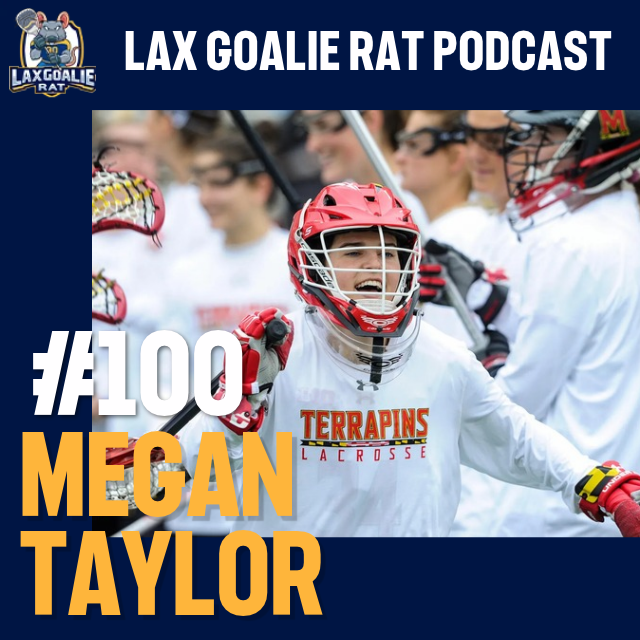
Megan Taylor on Goalie Fundamentals, Mental Toughness, and Becoming the First Goalie to Win the Tewaaraton Award
Episode Overview
For the 100th episode of the Lax Goalie Rat Podcast, Coach Damon sits down with one of the greatest lacrosse goalies to ever play the game, Megan Taylor of the University of Maryland.
Megan made history in 2019 as the first goalie to win the Tewaaraton Award. Her impressive career also includes the IWLCA Goaltender of the Year award, NCAA Tournament MVP, four-time Big Ten Goalie of the Year, and a Honda Sport Award for lacrosse.
In this conversation, Megan shares how she got started in goal thanks to her older brother, how she developed her quick reactions, and what helped her succeed at the highest level despite being just 5'3". She also discusses recovering from an ACL injury, managing pressure during her senior season, building confidence, and helping young goalies fall in love with the position.
What You'll Learn in This Episode
-
How Megan's older brother helped introduce her to lacrosse goalie
-
Why making the position fun is essential for developing young goalies
-
How playing multiple sports helped build her athleticism and reactions
-
Why positioning and explosive movement are especially important for shorter goalies
-
How to read shooters through their body language and shooting mechanics
-
How Megan recovered from an ACL injury and rebuilt her confidence
-
What she learned from Maryland's experienced leaders and team culture
-
How to communicate effectively and build confidence across the defense
-
Why the next-shot mentality is essential for goalies
-
How to balance hard work, recovery, and avoiding burnout
-
How Megan handled pressure during her championship-winning senior season
-
What makes her coaching approach effective with both developing and experienced goalies
Episode Highlights
1. Getting Started in Goal
Megan's goalie journey began in the backyard, where her older brother, Alex, needed someone to shoot on. She put on his equipment and started making saves. Those early sessions helped her become comfortable facing shots and taught her that playing goalie could be fun.
Megan emphasizes that young goalies need encouragement, positive reinforcement, and an environment where they feel excited to return to the cage.
2. Developing Quick Reactions and Better Positioning
Megan explains how years of backyard sessions, reaction drills, and facing different shooters helped her develop quick hands. She also learned to read a shooter's shoulders, body language, and release to anticipate where a shot might go.
Although reactions were a major strength, positioning became increasingly important when she reached Maryland. As a smaller goalie, she needed to stay disciplined, limit the visible net, and explode toward the ball without hesitation.
3. Overcoming an ACL Injury
After tearing her ACL during a field hockey game in high school, Megan had to navigate a long recovery and the uncertainty of returning to competition.
Her advice is to focus on the next milestone, celebrate small victories, and remember that progress takes time. Even when a goalie cannot participate fully, there are still ways to work on hand speed, reactions, and other skills as recovery allows.
4. Leadership and Communication at Maryland
Megan describes learning from teammates such as Taylor Cummings and Alice Mercer. Their leadership helped create an environment where she felt comfortable speaking up and contributing, even as a freshman.
On the field, Megan communicated where the ball was, alerted defenders to potential threats, and encouraged teammates after good plays. She also recognized when to take responsibility for a goal and when to acknowledge strong defensive work.
5. The Mental Game: Move On to the Next Shot
One of Megan's greatest strengths was her ability to move forward after allowing a goal. She did not dwell on a mistake or let one difficult stretch define the rest of the game.
She explains that good shooters will score, even when a goalie and defense do many things right. The key is to reset, trust the work you've put in, and prepare for the next opportunity.
Megan also highlights the importance of talking through doubts with someone you trust. Before Maryland's Final Four matchup against Northwestern, she shared her concerns with her brother. His encouragement helped her refocus on the opportunity in front of her.
6. Winning the Tewaaraton Award
Megan reflects on the pressure and excitement surrounding her senior season, including the expectations that came with being a Tewaaraton finalist.
She did not expect to win the award, and the announcement caught her by surprise. She also makes an important point: goalie success is never an individual achievement alone. Her award reflected the work of the defenders in front of her, who helped force opponents into shots she could save.
7. Training Smarter and Preventing Burnout
Megan enjoys reaction drills, tennis-ball work, turns, low-angle shots, and competitive drills that put her under pressure. She also shares a simple example of adapting equipment to address a technical issue, using a lanyard to help connect her head movement with her stick.
She encourages goalies to protect their bodies during practice, use padding when appropriate, and recognize when rest is necessary. Training should be purposeful, not simply about taking as many shots as possible.
8. Coaching the Next Generation
Now coaching goalies and defense at the United States Naval Academy, Megan wants young goalies to leave a session feeling excited about what they learned and eager to return.
Her coaching approach focuses on breaking down fundamentals, helping each goalie discover a style that works for them, and building the confidence to make big saves when the game is on the line.
Questions From the Goalie Community
Megan also answers questions from listeners about:
-
Making high saves as a shorter goalie
-
Developing a pre-eight-meter routine
-
Lessons lacrosse goalie has taught her about everyday life
-
The differences between men's and women's lacrosse goalie play
-
Feeling included as a goalie on a team
-
Her game-day warmup routine
-
Her transition from playing at Maryland to coaching at Navy
-
Her equipment, stick, and pocket preferences
Megan Taylor's Advice for Goalies
Megan's final message is simple: Enjoy the moment.
Whether you're playing youth lacrosse, competing in high school, or working toward the next level, appreciate where you are now. Keep learning, work toward your goals, and make the most of the time you have playing the sport.
About the Lax Goalie Rat Podcast
The Lax Goalie Rat Podcast, hosted by Coach Damon Wilson, is dedicated to lacrosse goalies, their families, and coaches who want to help goalies improve. Each episode explores the experiences, training methods, and mental approaches that help goalies perform at their best.